What Is The State of Blockchain Technology Projects?

Disclaimer: This article assumes that you have a basic understanding of Distributed Ledger Technology (DLT) and have some familiarity with blockchain vocabulary. If not, you can learn from these articles:
3. Beginners Guide to Blockchain
ICO’s (Initial Coin Offerings) and blockchain projects, in general, have taken media criticism over the past year making good on the promises of value. I believe this problem is 2-fold:
1. The rhetoric in the industry (and with many emerging technologies) is that the company’s specific project will induce major change, and provide tremendous value to shareholders. This makes sense, as it is a marketing technique to get potential token holders to buy into an ecosystem so that they can develop the product and/or application. However, this causes high expectations that are unfeasible in the time frame promised.
2. DLT and blockchain development is in infancy stage, and predicting development speed is difficult as there is not much precedence. Distributed Application (dApp) development provides a specific set of problems unconventional to traditional software development, especially in regards to User Interfaces. This includes signing transactions, interacting with wallets, and waiting for consensus and transactions to be written to the ledger. This causes a user experience that is generally suboptimal to traditional web applications and innovative solutions must be implemented to allow for a user experience on par with standard web applications.
On top of this, the cryptocurrency market has plummeted in 2018 losing significant investments of many blockchain enthusiasts across the world.
For more information on the history of Bitcoin, read this article.
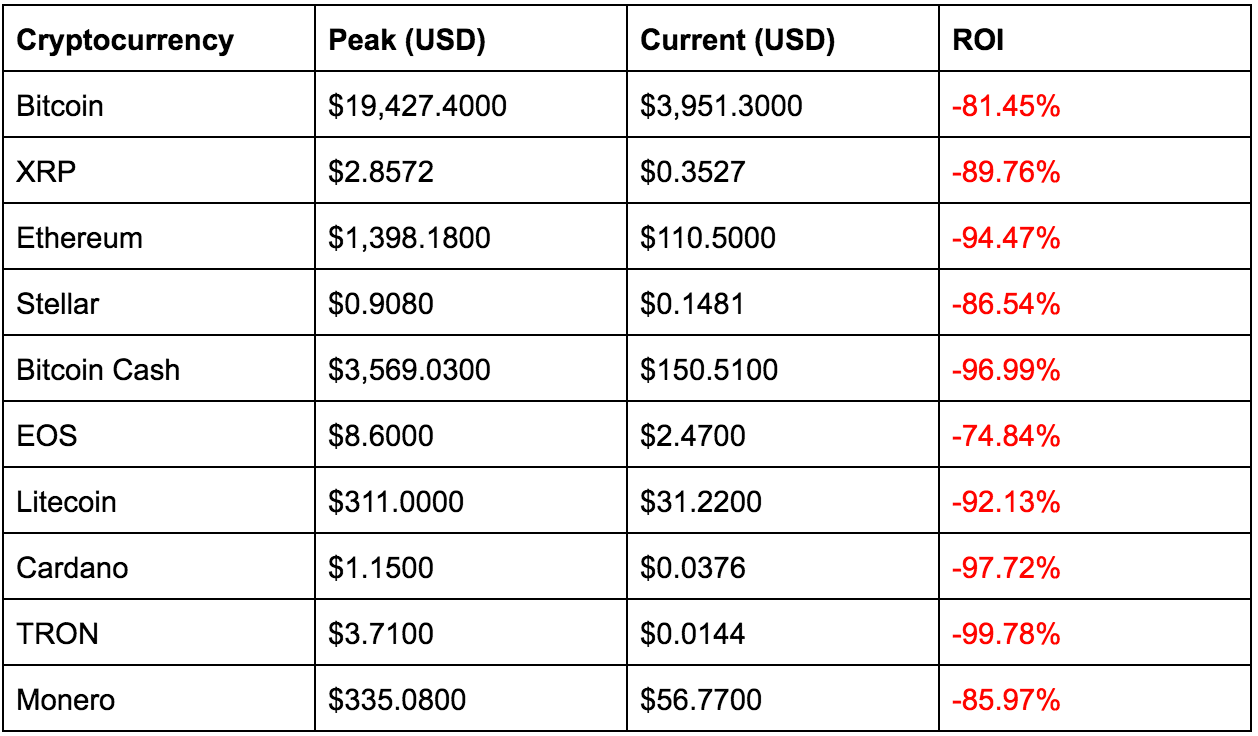
I believe one major cause for this crash is that the majority of people use cryptocurrencies as an investment platform as opposed to an improved transaction vehicle, as they are marketed as. Many people associate blockchain technology with cryptocurrencies, and because of the significant drop in value, assume blockchain technology has no value. Cryptocurrency is only a small portion of applications that can be developed through blockchain technology. Some examples of amazing projects that are in enterprise level production right now are:
1. IBM’s AI Crypto Anchor Verifier is a supply chain management and tracking solution that utilizes optical imaging and AI to verify product integrity throughout supply chains stored on a blockchain. Tracking of physical goods on blockchain is an increasingly popular technique that is being utilized throughout many industries. Using optical imaging on top of blockchain to verify product integrity for supply chain management ensures
2. Voatz is a blockchain based voting platform that allows for voting on mobile applications and just launched successful election results for 24 counties in West Virginia. Voatz is an extremely sexy alternative to in-person, paper voting as election manipulation becomes an increasingly concerning topic across the United States and the entire world.
3. Fluidity is a tokenization platform that offers FINRA-registered broker-dealers and issuers, services to integrate blockchain technology into their offerings. Fluidity has recently partnered with broker-dealer firms Propellr of real estate that tokenized a $36 million dollar estate in New York City. Tokenization of high-valued goods has the potential to be an innovative new financial tool for investors, significantly lowering the level of entree into these high-value markets as products can be virtually partitioned through tokenization.
Just as the dot com bubble of the early 2000s, Blockchain projects have been experienced a similar rise and fall with ideas to apply blockchain to a vast range of products and industries that don’t necessarily need it. Although the industry has been plagued by false promises and products that are, “launching next quarter,” there are still amazing enterprise products that are revolutionizing the way people interact with technology. The cryptocurrency crash of 2018 may decrease public perception of blockchain technology, but heavy amounts of investment, both in industry and academic research, are still driving the technology that is growing and improving at a rapid pace. As the infancy of blockchain technology matures, the best protocols will emerge and standards will form just as TCP/IP and HTTP did for the internet and blockchain technology will be as ingrained in our society in 2030 as the internet is in 2018.

Ken Miyachi is the CEO and co-founder of LedgerSafe, a blockchain based transactional and financial compliance platform. His background is in software engineering, specializing in distributed systems, architecture design, and machine learning.
Miyachi has applied his expertise across a variety interdisciplinary domains including computational biology research for the UCSD Dermatology Department, serverless architecture design of the SpatialVis Application, and advising Sheppard, Mullin, Richter, and Hampton on software patents and revitalizing their Intellectual Property automation and efficiency initiative.
He leverages his unique combination of technical expertise, economic insights, and legal strategies to develop, implement, and manage business objectives. Miyachi currently serves as a researcher at San Diego Supercomputer Centers BlockLAB and is the chair of the IEEE San Diego Blockchain Initiative.
Published January 18, 2019. Views are the author’s own and are not financial, legal or tax advice.